From Machine Learning to Autonomous Intelligence — Yann LeCun
“Yann LeCun systematically dismantles autoregressive LLMs for reasoning, proving why generative token prediction compounds errors exponentially and deriving Energy-Based Models and Joint Embedding Predictive Architectures (JEPA).”
Executive Summary: Beyond Autoregressive LLMs to Joint Embedding World Models
In this authoritative lecture, Turing Award laureate and Meta Chief AI Scientist Yann LeCun delivers a systematic critique of contemporary autoregressive Large Language Models (LLMs) and presents the mathematical and conceptual architecture for genuine Autonomous Machine Intelligence (AMI). LeCun argues that predicting tokens one by one is an evolutionary dead end for physical understanding and planning because auto-regressive error accumulation grows exponentially (divergence from the true manifold). Furthermore, predicting exact pixels or continuous state variables in generative models fails due to multi-modal uncertainty. LeCun derives the Joint Embedding Predictive Architecture (JEPA) and Energy-Based Models (EBM), showing how hierarchical latent state representations combined with non-contrastive regularization (VICReg) allow intelligent agents to learn world models, perceive abstract invariants, and perform model-predictive control planning in abstract representation space.
Key Mental Models Derived from this Lecture:
- Autoregressive Hallucination Theorem: Autoregressive generation compounds probability errors over sequence steps; the probability of staying on the correct manifold decays exponentially O(e^{-alpha T}).
- Generative vs Joint-Embedding: Generative architectures (VAEs, diffusion, LLMs) waste enormous capacity trying to predict unpredictable details (leaf patterns, wallpaper texture); JEPA predicts only in abstract feature space.
- Energy-Based Models (EBM): Rather than computing normalized probabilities P(y|x) which requires impossible integrals, EBMs assign low scalar energy to compatible (x, y) pairs and high energy to incompatible ones.
- Informational Collapse Avoidance: In non-contrastive joint embedding, the network naturally wants to output a constant vector (zero energy everywhere). Regularizers like VICReg mathematically enforce non-zero variance and orthogonal covariance.
- Hierarchical World Models: Multi-level JEPAs allow reasoning at multiple timescales: low-level representations predict fractions of seconds, while high-level abstractions predict hours or days.
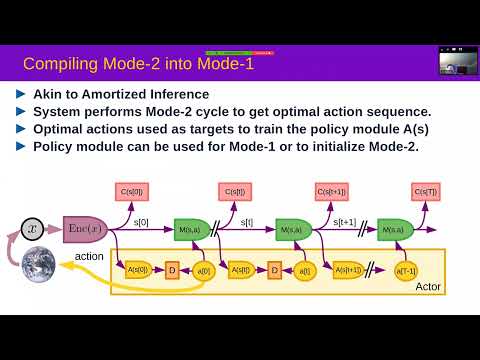
- Perception-Action-Planning Loop: Autonomous intelligence consists of a Configurator, World Model, Actor, Critic, and Perception system optimized via Gradient-Based Model Predictive Control.
Key Timestamps: Yann LeCun World Models and JEPA Breakdown
The Limits of Autoregressive LLMs & Animal Intelligence
Energy-Based Models vs Normalized Probabilistic Models
Joint Embedding Predictive Architecture (JEPA) Mechanics
VICReg Formulation: Variance, Invariance, Covariance
Mathematical Derivations: Energy-Based Models, Free Energy & VICReg
Free Energy Formulation in Energy-Based Models
When predicting future y from x under latent uncertainty z (e.g., multiple plausible future paths), the free energy marginalizes over latent variables. At zero temperature (beta -> infty), it reduces to finding the optimal latent variable that minimizes the energy of the pair.
JEPA Prediction Loss in Latent Space
Instead of predicting raw pixels y from x, JEPA maps both through encoders and predicts the representation s_y. The loss is computed strictly in representation space, making the system invariant to unpredictable high-frequency noise.
VICReg Non-Contrastive Regularization Loss
The three terms represent: (1) Invariance D(s_x, s_y) matching corresponding embeddings; (2) Variance ensuring every feature dimension maintains standard deviation above threshold gamma to prevent collapse to a point; (3) Covariance driving off-diagonal cross-correlations to zero to eliminate redundant representations.
Community Consensus: Hacker News Debates on LLMs vs World Models
Autoregressive LLMs (Sutskever/OpenAI) vs Joint Embedding (LeCun/Meta)
“LeCun’s paper on A Path Towards Autonomous Machine Intelligence is the cleanest conceptual critique of generative slop. You simply cannot predict the position of every dust particle to decide where to steer a car.” — @roboticist_hn
Representation Collapse: Contrastive vs Non-Contrastive Approaches
“VICReg is one of the most elegant loss functions ever devised in self-supervised learning. It mathematically guarantees that dimensions don't collapse without needing negative samples.” — @ylecun_fan
Technical FAQ: JEPA, Representation Collapse, VICReg and Energy-Based Planning
Why does Yann LeCun state that generative autoregressive models are doomed for physical planning?
Because autoregression predicts exact future states in output space. In the real world, the future is uncertain and continuous. Trying to generate every pixel or token causes catastrophic error accumulation O(e^T).
What is the difference between Generative AI and Joint Embedding Architecture (JEPA)?
Generative AI tries to reconstruct or predict the full sensory input (pixels, audio, text). JEPA predicts only the abstract feature representation, discarding irrelevant details like grass motion or background noise.
How does VICReg prevent representation collapse without negative pairs?
VICReg explicitly adds a variance loss (forcing each embedding dimension's standard deviation >= 1) and a covariance loss (forcing off-diagonal covariance to 0), making collapse mathematically impossible.