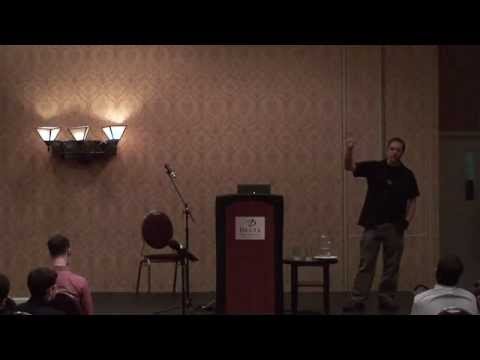
Inventing on Principle — Bret Victor
“One of the most life-altering talks any software developer can watch. Changed the way I think about tools, feedback loops, and guiding life principles forever.”
Executive Summary: Inventing on Principle and Immediate Tactile Connection
Inventing on principle by Bret Victor stands as a foundational manifesto on technology delivered at CUSEC 2012. Bret Victor’s Inventing on Principle deconstructs creative empowerment. Victor argues that extraordinary creators and computer pioneers are not driven by mere craft, style, or commercial demand, but by an unyielding personal principle—a moral compass defining an injustice they refuse to tolerate. For Victor, that principle is: “Creators need an immediate, tactile connection to what they create.” Through live reactive programming environments that predate modern developer tooling by decades, Victor demonstrates that the conventional edit-compile-run development loop imposes a fatal cognitive latency that breaks human creative thought. When programmers are forced to simulate execution blindly in their heads, their minds operate under artificial cognitive friction, stifling real-time discovery and spatial reasoning. By demonstrating real-time interactive game design, dynamic electronic circuit simulation, and algorithm spatialization, Victor challenges programmers to commit to inventing on principle, abandoning passive text editors to build computing media that empower human intuition.
Key Mental Models Derived from this Lecture:
- The Cognitive Feedback Threshold: Inventing on principle requires immediate feedback loops (Delta_t < 100ms); delayed compilation destroys human creative flow while inventing software.
- Inventing on Principle vs. Living by Craft: A craftsman masters tools and follows demands; when inventing on principle, a principled creator invents new worlds to dismantle an injustice.
- Direct Spatial Manipulation: When inventing on principle, abstract variables must be tangible dials and visual trajectories, empowering creators while inventing algorithms.
- Spatializing Time over History: Instead of temporal debugging (print statements and step-over breakpoints), computation history should be unfolded spatially across the screen.
- The Blind Simulation Trap: Software engineering forces developers to construct a faulty mental compiler in their heads to imagine execution, which guarantees bugs and limits architectural scope.
- The Moral Duty of Inventing on Principle: Software tools dictate the boundaries of human thought; inventing on principle demands replacing obsolete teletype paradigms.
Key Timestamps: Inventing on Principle Lecture and Live Demos
The Core Premise: Why Living by a Principle Supersedes Craft
Live Reactive Canvas Demo: Dynamic Parameter Scrubbing
Electronic Circuit Simulation with Live Waveforms
Visualizing Algorithm State Over Time in Binary Search
Historical Principles: Larry Tesler, Richard Stallman and Alan Kay
The Call to Action: Finding Your Non-Negotiable Principle
Theoretical Formulations: Feedback Latency and Cognitive Flow
Human Cognitive Feedback Latency Threshold
Experimental psychology demonstrates that when visual feedback occurs within 100 milliseconds, the human brain perceives the reaction as direct physical causation. When feedback latency exceeds 1.0 second, working memory is cleared, interrupting exploratory cognitive flow.
# Reactive canvas continuous update loop without compilation delay
def on_variable_scrub(param_name, new_val):
    state.update_param(param_name, new_val)
    renderer.render_full_simulation_frame(state) # Evaluates in <16ms (60 FPS)
Continuous Parameter Space Manifold Mapping
Instead of testing discrete point values of parameters p, reactive systems compute the entire continuous phase space manifold, allowing engineers to visualize bifurcations and stability envelopes dynamically.
# Instantaneous phase space visualization of dynamical system
t_span = np.linspace(0, 10, 500)
trajectories = [solve_ivp(dynamics, t_span, y0, args=(p,)).y for p in param_range]
plot_phase_space(trajectories) # Live reactive visual canvas
Temporal-to-Spatial Dimensional Projection
Traditional debuggers force programmers to step linearly through discrete clock ticks. Victor’s spatial projection algorithm unrolls execution time along an extra spatial geometric axis, displaying all historical branches simultaneously.
# Unrolling recursive algorithm state along spatial coordinate axis
def visualize_tree_history(root):
    for depth, node in enumerate(traverse_levels(root)):
draw_bounding_box(node.state, x=node.pos, y=depth * LAYER_HEIGHT)Community Consensus: Hacker News Debates on Bret Victor’s Principle
Why Haven’t Mainstream IDEs Adopted Bret Victor’s Reactive Vision?
“This talk made me realize we are still using 1970s teletype technology wrapped in Electron browser windows. Bret revealed how primitive our development tools truly are.” — @antirez
Living by Principle vs. Professional Pragmatism in Startup Engineering
“If everyone was pragmatic, we would still be punching cards with high efficiency. Victor’s message is that someone has to stand up for human capability over convenience.” — @swyx
Visual Programming vs Text-Based Code: The Expressive Density Debate
“People confuse Bret Victor with Scratch. He isn't saying don't write code; he’s saying don't write code blindly without seeing the consequences immediately.” — @breck
Technical FAQ: Reactive Programming, Subretina and Creator Principles
In Simple Made Easy, what is the fundamental difference between Simple and Easy?
In the Simple Made Easy lecture by Rich Hickey, Simple is an objective design property (simplex: having a single role, unbraided), whereas Easy is subjective and relative to developer familiarity (facilis: near at hand).
What does the Simple Made Easy lecture mean by the verb “to complect”?
In Simple Made Easy, to complect means to braid, intertwine, or fold multiple distinct concerns together (from Latin complecti). Once concepts are complected, you cannot reason about or test one without dragging the other along.
Why does Simple Made Easy advocate for immutable values over mutable state?
Simple Made Easy proves that mutable state braids value and time together. Immutable values represent permanent historical facts that can be freely shared across concurrent threads without locks, cached indefinitely, and trivially reasoned about.
How does the Epochal Time Model in Simple Made Easy solve concurrency?
In Simple Made Easy, identity is an atomic reference pointing to an immutable value snapshot at time t. Updates apply a pure function to produce a new immutable value at t+1 and swap the reference atomically (e.g. CAS), allowing lock-free reads.
Why does Simple Made Easy recommend passing plain data maps instead of OOP classes?
In Simple Made Easy, plain associative maps represent information directly without braiding data representation with domain logic or class inheritance hierarchies, enabling universal composition.
What architectural constructs does Simple Made Easy recommend for decoupled systems?
Simple Made Easy recommends five foundational constructs: persistent immutable data structures, declarative data (like JSON or EDN), asynchronous queues to decouple space and time, pure functions, and runtime schemas.