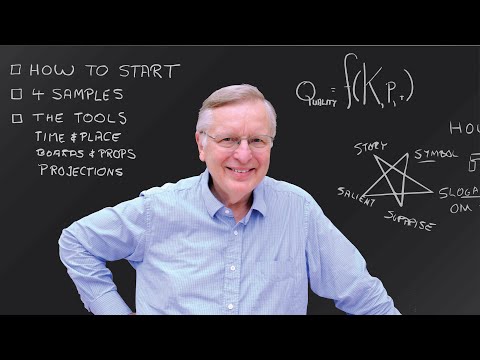
How to Speak: MIT Lecture — Patrick Winston
“Winston's annual MIT lecture on communication, lecturing, and persuasion. His rules on pacing, the 'Time & Place' rule, and blackboard usage are timeless.”
Executive Summary: The Winston Formula and Rules of Technical Speaking
Patrick Winston’s “How to Speak” is a legendary MIT OpenCourseWare lecture that has guided generations of computer scientists, engineers, researchers, and entrepreneurs to mastery in technical communication. Winston, the former director of the MIT Artificial Intelligence Laboratory, demonstrates that professional success is dictated far more by one's ability to speak, write, and communicate ideas than by raw technical ability alone. Presenting his celebrated heuristic formula, Quality = f(Knowledge, Practice, Inherent Ability), Winston proves that while inherent talent has a negligible weight of 0.1, knowledge of speaking heuristics and deliberate practice comprise 90% of communicative power. Winston unpacks practical, actionable rules: why you must never start with a joke, the “Uniform Code of Time and Place,” why blackboards and chalk outperform PowerPoint slides, how to use physical props to create indelible cognitive anchors, how to “salt” technical presentations to re-engage drifting audiences, and why you should never conclude with “Thank You.”
Key Mental Models Derived from this Lecture:
- The Winston Quality Formula: Quality = f(Knowledge, Practice, Inherent Ability) where Knowledge and Practice dominate (0.1 weight on natural talent).
- The Pacing of Chalk: Writing on a physical board or tablet matches human cognitive assimilation speed (~1 word/sec), whereas clicking PowerPoint slides overwhelms working memory.
- Cognitive Anchoring with Physical Props: Physical artifacts (an armadillo, a laser pointer, a prototype board) anchor abstract mathematical or computational concepts in long-term memory.
- Salting the Talk: Periodically deploying intriguing technical teasers, unexpected counter-examples, or open problems to draw wandering minds back into focus.
- The Fence (Pruning Boundaries): Clearly defining what your research/system does not do establishes professional credibility and protects against dismissive cross-examination.
- Ending with a Contribution, Not a Platitude: Never close a talk with “Thank You” or “Questions?”; conclude with a summary slide showcasing your specific novel contribution to the discipline.
Key Timestamps: MIT How to Speak Lecture Breakdown
The Importance of Speaking: Why Communication Determines Technical Impact
How to Start: The Uniform Code of Time and Place
The Four Delivery Media: Chalkboards, Overheads, Props, and Slides
Special Heuristics: Fencing, Salting, and Re-engaging the Audience
Rules for Technical Slides: Eliminating Bullets, Lasers, and Visual Clutter
How to Conclude: Replacing “Thank You” with Your Core Technical Contribution
Structural Formulations: The Speaking Quality Equation and Heuristics
The Winston Speaking Quality Equation
Winston’s formula models speaking effectiveness. Because inherent ability has an exponent of 0.1, a person with 10x more natural talent is only 1.25x more effective. Knowledge of speaking principles and deliberate practice drive 90% of communicative power.
# Winston Quality Model calculation
def speech_quality(knowledge_score, practice_hours, innate_talent=1.0):
    # Knowledge (0-10), Practice (hours), Talent (1-10)
    return knowledge_score * practice_hours * (innate_talent ** 0.1)

# Notice: High practice + heuristics vastly dominates high raw talent alone
assert speech_quality(9, 50, 1) > speech_quality(2, 5, 10)
Cognitive Assimilation Rate Differential (Chalkboard vs Slide Projection)
Human working memory can process speech and written concepts at roughly 1 word per second. Writing on a physical board naturally throttles the speaker to the speed of cognitive assimilation, while clicking a text-heavy slide triggers visual overload.
# Human cognitive absorption threshold vs presentation media speed
SPEECH_COMPREHENSION_RATE = 1.0 # words per second
SLIDE_CLICK_WORDS = 40 # words flashed in 1 second
CHALK_WRITE_RATE = 0.9 # words written per second (matches comprehension perfectly)
Audience Attention Decay and Salting Regeneration Function
Audience attention decays exponentially with time constant lambda. Salting events (props, intriguing questions, dramatic pause, counter-intuitive facts) act as delta impulses that reset audience attention back to maximum.
# Modeling audience attention regeneration through Winston Salting
def simulate_attention(time_minutes, salt_intervals=[15, 30, 45]):
    attention = 1.0
    for t in range(time_minutes):
        attention *= 0.96 # Exponential decay
        if t in salt_intervals:
            attention = 1.0 # Salting restores full attention
return attentionCommunity Consensus: Hacker News Debates on Patrick Winston’s Rules
Chalkboards vs Modern Slidedecks: Is Winston’s Board Rule Valid in Remote Zoom Talks?
“Winston’s rule isn't literally about chalk; it’s about rate of transmission. The moment you flash a slide with 5 bullet points, the audience stops listening to you.” — @mit_alum_2012
Why Do Speakers Still End with “Thank You” Despite Winston’s Warning?
“The best advice I ever got was replacing 'Thank You' with a slide summarizing our 3 core findings and code repo. It turned our conference talks into inbound job offers.” — @phd_survivor
Technical Substance vs Speaking Polish: The Hacker Skepticism
“Good speaking doesn't mean becoming a snake-oil salesman. It means not torturing your colleagues with 60 slides of unreadable code.” — @kernel_hacker
Technical FAQ: Chalkboards vs Slides, Pacing, Fences and Winston’s Laws
In Simple Made Easy, what is the fundamental difference between Simple and Easy?
In the Simple Made Easy lecture by Rich Hickey, Simple is an objective design property (simplex: having a single role, unbraided), whereas Easy is subjective and relative to developer familiarity (facilis: near at hand).
What does the Simple Made Easy lecture mean by the verb “to complect”?
In Simple Made Easy, to complect means to braid, intertwine, or fold multiple distinct concerns together (from Latin complecti). Once concepts are complected, you cannot reason about or test one without dragging the other along.
Why does Simple Made Easy advocate for immutable values over mutable state?
Simple Made Easy proves that mutable state braids value and time together. Immutable values represent permanent historical facts that can be freely shared across concurrent threads without locks, cached indefinitely, and trivially reasoned about.
How does the Epochal Time Model in Simple Made Easy solve concurrency?
In Simple Made Easy, identity is an atomic reference pointing to an immutable value snapshot at time t. Updates apply a pure function to produce a new immutable value at t+1 and swap the reference atomically (e.g. CAS), allowing lock-free reads.
Why does Simple Made Easy recommend passing plain data maps instead of OOP classes?
In Simple Made Easy, plain associative maps represent information directly without braiding data representation with domain logic or class inheritance hierarchies, enabling universal composition.
What architectural constructs does Simple Made Easy recommend for decoupled systems?
Simple Made Easy recommends five foundational constructs: persistent immutable data structures, declarative data (like JSON or EDN), asynchronous queues to decouple space and time, pure functions, and runtime schemas.