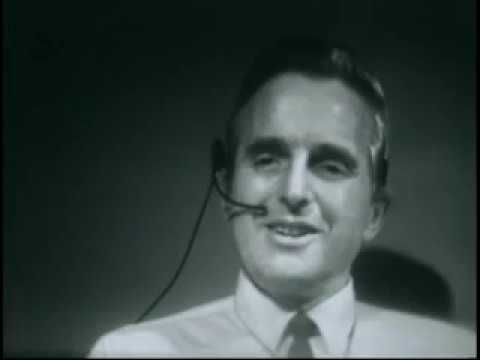
The Mother of All Demos 1968 — Douglas Engelbart
“He unveiled the computer mouse, hypertext, windows, video conferencing, real-time collaborative text editing, and version control in a single 1968 presentation. Staggering.”
Executive Summary: Augmenting Human Intellect and the NLS Debut
On December 9, 1968, at the Fall Joint Computer Conference in San Francisco, Dr. Douglas Engelbart and his team from the Augmentation Research Center (ARC) at Stanford Research Institute (SRI) presented a 90-minute live demonstration that fundamentally presaged modern personal computing. Now universally revered as “The Mother of All Demos,” the presentation showcased the NLS (oN-Line System) running on an SDS 940 mainframe connected via leased microwave video lines. In a single cohesive system, Engelbart unveiled the world debut of the computer mouse, full-screen text editing, dynamic windowing, structured hierarchical hypertext links, real-time audio and video conferencing, screen sharing, and collaborative document editing. Engelbart’s overarching vision was not merely office automation, but “Augmenting Human Intellect”—empowering knowledge workers to solve humanity's increasingly urgent and complex systemic problems through interactive computing.
Key Mental Models Derived from this Lecture:
- Bootstrapping Collective IQ: The purpose of computing is not automating clerical tasks, but amplifying collective human capability to navigate complex distributed problem domains.
- The Dual-Hand Interface (Mouse + Chording Keys): One hand operates a pointing device for continuous spatial navigation, while the other operates a 5-key chorded keyset for simultaneous symbolic command execution.
- Hierarchical View Specifications (Outline Hierarchy): Documents are not flat linear paper sheets; they are structured knowledge graphs with variable depth, branch collapsing, and semantic cross-linking.
- Real-Time Distributed Telecollaboration: Multiple remote operators sharing cursor positions, audio streams, and split-screen buffers simultaneously over networked communication channels.
- The H-LAM/T Framework (Human using Language, Artifacts, Methodology, and Training): Technology artifacts are useless without co-evolving organizational methodologies and rigorous human training.
- Direct Object-Verb Manipulation: Transitioning from batch-card programming to direct on-screen selection and immediate state manipulation.
Key Timestamps: The 1968 Mother of All Demos Breakdown
Introduction & The Philosophy of Augmenting Human Intellect
The First Public Computer Mouse & Cursor Screen Tracking
Hierarchical Hypertext Linking & Flexible View Specifications
Real-Time Collaborative Screen Sharing & Dual-User Editing
Video Teleconferencing & Split-Screen Remote Mainframe Control
The 5-Key Chording Keyset and High-Throughput Information Navigation
Architectural Formulations: Hierarchical Hypertext and Chording Keys
Engelbart’s Augmentation System Equation
Engelbart argued that technological artifacts represent only one component of augmentation. Enhancing collective problem-solving capability requires co-evolving human language, institutional methodologies, and rigorous user training simultaneously.
# Conceptual representation of the Engelbart Augmentation Pipeline
class AugmentedSystem:
    def __init__(self, human, artifacts, methodologies, training_level):
        self.human = human
        self.artifacts = artifacts # NLS, Mouse, High-resolution displays
        self.methodologies = methodologies # Hypertext, shared journals
        self.training = training_level # Expert chording fluency

    def effective_iq(self, task_complexity):
        return (self.artifacts.power * self.training) / task_complexity
NLS Hierarchical Node Addressing Protocol
Every character, word, statement, and branch in NLS had a deterministic universal address. View specifications allowed users to filter documents by structural depth (e.g. show only top-level headers) and inline link cross-references.
# NLS Universal Link and View Specification Resolver
def resolve_nls_link(doc_tree, link_address):
    # Format: 1a.3b:view_level=2
    statement, view_spec = parse_address(link_address)
    node = doc_tree.lookup(statement)
    return apply_view_filter(node, max_depth=view_spec.level)
Coordinate Transformation for 2D XY Mouse Potentiometers
The original wooden mouse housed two perpendicular metal wheels connected to potentiometers. As the wheels rolled across the desk, analog rotational encoders produced coordinate offsets mapped directly to raster cathode ray tube (CRT) deflection plates.
# Analog potentiometer coordinate translation loop
def update_cursor_position(pot_x_val, pot_y_val):
    cursor.x = clamp(cursor.x + (pot_x_val * SCALE_FACTOR), 0, SCREEN_WIDTH)
    cursor.y = clamp(cursor.y + (pot_y_val * SCALE_FACTOR), 0, SCREEN_HEIGHT)
crt_beam.deflect_to(cursor.x, cursor.y)Community Consensus: Hacker News Debates on Douglas Engelbart’s Vision
Why Did Commercial Personal Computing Discard the 5-Key Chording Keyset?
“Engelbart designed tools for jet pilots; Steve Jobs redesigned tools for passengers. We gained accessibility but lost unimaginable expert throughput.” — @alan_kay_disciple
Engelbart’s Vision vs Modern Social Media Algorithmic Enshittification
“In 1968, Engelbart demonstrated a tool to make humans smarter. In 2026, algorithmic video platforms make humans dumber. HackerTube is the return to 1968.” — @ted_nelson_fan
NLS Hypertext vs Tim Berners-Lee’s World Wide Web
“The web is a degraded version of what Engelbart built 20 years earlier. We traded structural integrity for ease of authoring.” — @hypertext_vet
Technical FAQ: NLS Architecture, Computer Mouse and Engelbart’s Laws
In Simple Made Easy, what is the fundamental difference between Simple and Easy?
In the Simple Made Easy lecture by Rich Hickey, Simple is an objective design property (simplex: having a single role, unbraided), whereas Easy is subjective and relative to developer familiarity (facilis: near at hand).
What does the Simple Made Easy lecture mean by the verb “to complect”?
In Simple Made Easy, to complect means to braid, intertwine, or fold multiple distinct concerns together (from Latin complecti). Once concepts are complected, you cannot reason about or test one without dragging the other along.
Why does Simple Made Easy advocate for immutable values over mutable state?
Simple Made Easy proves that mutable state braids value and time together. Immutable values represent permanent historical facts that can be freely shared across concurrent threads without locks, cached indefinitely, and trivially reasoned about.
How does the Epochal Time Model in Simple Made Easy solve concurrency?
In Simple Made Easy, identity is an atomic reference pointing to an immutable value snapshot at time t. Updates apply a pure function to produce a new immutable value at t+1 and swap the reference atomically (e.g. CAS), allowing lock-free reads.
Why does Simple Made Easy recommend passing plain data maps instead of OOP classes?
In Simple Made Easy, plain associative maps represent information directly without braiding data representation with domain logic or class inheritance hierarchies, enabling universal composition.
What architectural constructs does Simple Made Easy recommend for decoupled systems?
Simple Made Easy recommends five foundational constructs: persistent immutable data structures, declarative data (like JSON or EDN), asynchronous queues to decouple space and time, pure functions, and runtime schemas.