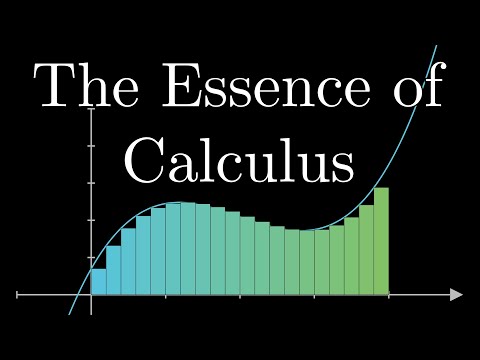
The Essence of Calculus, Chapter 1 — 3Blue1Brown
“Grant Sanderson accomplishes in 17 minutes what standard high school and college professors fail to do in months: build geometric intuition for what an integral and derivative actually mean.”
Executive Summary: Geometric Intuition of Derivatives and Integrals
Grant Sanderson’s “The Essence of Calculus, Chapter 1” is the opening masterclass of the critically acclaimed 3Blue1Brown mathematics series. Sanderson introduces the core philosophical foundation of calculus: the art of approximating complex, continuously changing non-linear problems by breaking them into an infinite number of simple, linear pieces. Using a profound geometric example—finding the exact area of a circle without relying on rote memorization—Sanderson peels a circle into thin concentric rings of thickness dr. By unrolling these rings and stacking them vertically, they form a right triangle with base 2*pi*r and height r, deriving the area formula A = (1/2) * (2*pi*r) * r = pi*r^2 from first principles. This visual derivation demonstrates that integration (summing thin rings) and differentiation (the rate of change of area with respect to radius, dA/dr = 2*pi*r) are dual inverse operations, forming the conceptual bedrock of physics, engineering, and deep learning backpropagation.
Key Mental Models Derived from this Lecture:
- Calculus as the Mathematics of Local Linearity: Any smooth continuous curve or surface, when zoomed in close enough, behaves like a straight line or flat plane.
- Peeling and Stacking (Integration): Complex spatial volumes can be computed by slicing them into thin canonical slices (dx, dr) and summing their contributions.
- The Dual Nature of the Derivative: The derivative dA/dr is both the slope of a tangent line and the physical boundary layer added when an object expands by dr.
- Infinitesimal Increments (dr -> 0): Infinitesimals are not mystical entities; they are algebraic tools where higher-order terms like (dr)^2 vanish in the continuous limit.
- Geometry Preceding Algebra: Algebraic formulas in calculus are merely symbolic descriptions of underlying spatial, physical, and geometric relationships.
- The Fundamental Theorem of Calculus: The area under a rate-of-change curve reconstructs the cumulative quantity, and the derivative of an accumulation function recovers the rate of change.
Key Timestamps: The Essence of Calculus Chapter 1 Breakdown
What is Calculus? Approximating Curved Reality with Straight Lines
The Geometric Puzzle: Deriving Circle Area from First Principles
Unrolling Concentric Rings into a Right Triangle
The Derivative Revealed: Why dA/dr Equals the Circumference 2*pi*r
The Dual Nature of Limits: Why (dr)^2 Vanishes Safely
The Road Ahead: How Derivatives and Integrals Unite in Physics and AI
Mathematical Derivations: Infinitesimal Circle Area and Polynomials
Geometric Circle Area via Riemann Ring Integration
A circle of radius r is partitioned into concentric rings of radius s and infinitesimal thickness ds. Each unrolled ring has length 2*pi*s and area 2*pi*s*ds. Integrating these linear slices from 0 to r produces the exact area pi*r^2.
# Numerical verification of 3Blue1Brown circle unrolling integration
import numpy as np

def circle_area_unroll(r, n_rings=10000):
    dr = r / n_rings
    radii = np.linspace(0, r, n_rings)
    ring_areas = 2 * np.pi * radii * dr
    return np.sum(ring_areas)

r_val = 5.0
computed = circle_area_unroll(r_val)
theoretical = np.pi * (r_val ** 2)
assert np.isclose(computed, theoretical, rtol=1e-3)
Derivation of the Derivative as a Boundary Expansion
Expanding (r + dr)^2 yields r^2 + 2r*dr + (dr)^2. Subtracting r^2 and dividing by dr leaves 2r + dr. As dr approaches zero, the second-order term vanishes, leaving the exact circumference 2*pi*r.
# Symbolically verifying the boundary derivative
import sympy as sp

r, dr = sp.symbols('r dr')
A = sp.pi * r**2
A_expanded = sp.pi * (r + dr)**2
dA = sp.simplify((A_expanded - A) / dr)
# As dr -> 0, dA/dr = 2*pi*r
derivative = sp.limit(dA, dr, 0)
assert derivative == 2 * sp.pi * r
Polynomial Power Rule Geometric Formulation
For a square of area x^2, expanding x by dx adds 2 outer strips of area x*dx, yielding d/dx(x^2) = 2x. For a cube of volume x^3, expanding by dx adds 3 outer faces of area x^2*dx, yielding d/dx(x^3) = 3x^2.
# Visualizing n-dimensional hypercube boundary expansion
def hypercube_face_derivative(x, n):
    # An n-cube of side x has volume x^n. Expanding by dx adds n faces of area x^(n-1)
return n * (x ** (n - 1))Community Consensus: Hacker News Debates on Visualizing Calculus
Why Isn’t Calculus Taught Geometrically in High Schools and Colleges?
“I spent two semesters memorizing differentiation rules for exams. Grant Sanderson explained the entire concept in 17 minutes using three unrolled rings.” — @math_convert
Does 2D Geometric Intuition Scale to High-Dimensional Machine Learning?
“Backpropagation is literally just the chain rule applied to Grant’s concentric rings, generalized to a directed acyclic graph of tensor operations.” — @gradient_descent_fan
3Blue1Brown’s Manim Software as an Educational Paradigm
“Manim is the visual medium Bret Victor dreamed of. It turns abstract algebraic equations into moving spatial structures.” — @manim_animator
Technical FAQ: Geometric Derivatives, Infinitesimals and ML Intuition
In Simple Made Easy, what is the fundamental difference between Simple and Easy?
In the Simple Made Easy lecture by Rich Hickey, Simple is an objective design property (simplex: having a single role, unbraided), whereas Easy is subjective and relative to developer familiarity (facilis: near at hand).
What does the Simple Made Easy lecture mean by the verb “to complect”?
In Simple Made Easy, to complect means to braid, intertwine, or fold multiple distinct concerns together (from Latin complecti). Once concepts are complected, you cannot reason about or test one without dragging the other along.
Why does Simple Made Easy advocate for immutable values over mutable state?
Simple Made Easy proves that mutable state braids value and time together. Immutable values represent permanent historical facts that can be freely shared across concurrent threads without locks, cached indefinitely, and trivially reasoned about.
How does the Epochal Time Model in Simple Made Easy solve concurrency?
In Simple Made Easy, identity is an atomic reference pointing to an immutable value snapshot at time t. Updates apply a pure function to produce a new immutable value at t+1 and swap the reference atomically (e.g. CAS), allowing lock-free reads.
Why does Simple Made Easy recommend passing plain data maps instead of OOP classes?
In Simple Made Easy, plain associative maps represent information directly without braiding data representation with domain logic or class inheritance hierarchies, enabling universal composition.
What architectural constructs does Simple Made Easy recommend for decoupled systems?
Simple Made Easy recommends five foundational constructs: persistent immutable data structures, declarative data (like JSON or EDN), asynchronous queues to decouple space and time, pure functions, and runtime schemas.